Does Your Rice Routine Need a Dedicated Cooker?

Keep a saucepan or rice cooker that already works for you. Consider a dedicated cooker only when recurring rice meals justify its size, controls and upkeep.
Keep a saucepan and lid, or a rice cooker, that already handles your usual rice meals well. Even if you make rice often, another appliance needs a reason to take up space.
The Zojirushi NS-TSC10 is worth considering when you want a dedicated appliance for a recurring rice-cooking job and are willing to make room for its controls and removable parts. This guide covers one 5.5-rice-cup model in Stainless Brown (-XJ).
Start with the routine you would replace
Think about the rice meals you actually repeat, the uncooked amounts you use and what bothers you about your current setup. If your saucepan routine is familiar and satisfactory, keeping it avoids another purchase and another appliance to store. If an existing cooker already suits those meals, extra menu choices alone are a weak reason to replace it.
A dedicated cooker is a more relevant option when rice preparation is a recurring task you want to move to a separate appliance. Before choosing this one, settle the size and ownership questions below rather than assuming it will improve your results.
Read the 5.5-cup label before choosing a size
Zojirushi rates this model for up to 5.5 of its approximately 180 mL rice measuring cups, using raw short-grain white rice. That does not mean 5.5 U.S. measuring cups, cooked-rice volume or a particular number of servings. The maker says other grains may vary.
Check the supported quantities for the rice types and uncooked amounts you normally prepare in the exact model's instructions before ordering. A household headcount or the largest number on the box is not enough to choose a size.

Look at the controls you would use
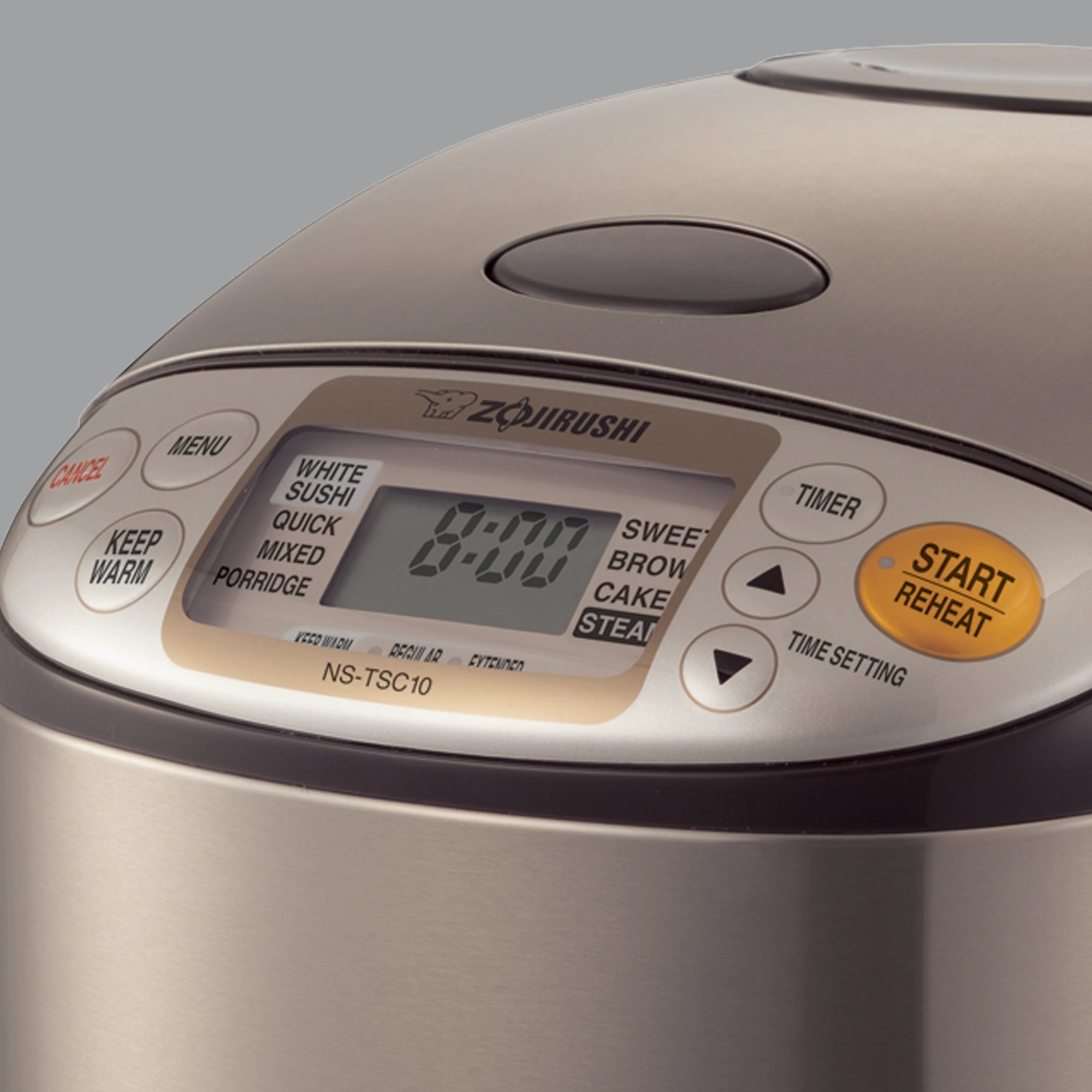
The NS-TSC10 has an LCD and separate Menu, Timer and Start/Reheat controls. The enlarged view below shows the interface more clearly than the whole-appliance photo. Decide whether you want to learn and use that interface for your ordinary rice meals; you do not need a plan to use every menu label.
Account for the pan and inner lid
Ownership includes maintaining the separate cooking pan and detachable inner lid. Consider those pieces along with the body when planning cleanup and storage, rather than judging the appliance only by its closed-lid outline.

The lid photo is a view of one detached part. Do not treat it as instructions for washing the electrical body. Use the complete care instructions supplied with the exact cooker; this guide does not establish a cleaning procedure.
Check the accessory list, not just the photo
Zojirushi lists a steaming basket, rice measuring cup, spatula and spatula holder. The selected Amazon gallery shows the basket, but Amazon's shorter included-components field omits it. Verify the contents of the selected package before ordering, rather than treating that omission as proof that the basket is missing.

Keep the rice-cooking job central to the decision. An extra accessory does not justify the purchase if your current setup is adequate. The basket photo also does not establish how to combine cooking tasks.
Make room for the appliance you will keep
The U.S. model is rated for 120 volts; do not assume worldwide-voltage compatibility. Plan a suitable outlet, counter or storage space, and room to open the lid. Check the supplied placement requirements rather than relying only on the body's dimensions.
Consider this cooker only when the recurring rice job, supported batch sizes, interface and upkeep all fit your routine. If size or placement remains uncertain, resolve it before buying. Keeping a suitable pot or current cooker is a complete answer, not a temporary compromise.
Before ordering, confirm NS-TSC10, the 5.5-rice-cup size, Stainless Brown (-XJ), and one unit. Amazon's generic color field calls it Brown. Do not switch to a different size, white version or bundle and assume this guide still applies. View the Zojirushi NS-TSC10 on Amazon.
How we chose
This source-based guide uses the selected Amazon listing and Zojirushi product information, not hands-on testing. The manufacturer-linked manual was unavailable, so cooking and cleaning procedures are not covered here. Follow the complete instructions supplied with the exact appliance.