Ticket to Ride for Two or Three: Expect Competition for Routes

Two or three players still compete for connections. The original Ticket to Ride closes parallel routes and subtracts points for unfinished destinations.
Ticket to Ride works with two or three players, but fewer players do not mean everyone gets an open lane. In the original North America game, claiming one side of a double route closes the other side in a two- or three-player game. If your group enjoys building a plan while opponents can get in the way, that restriction is part of the appeal. If everyone wants to finish a route undisturbed, it is an important mismatch.
Collecting the cards does not reserve the connection
A turn gives you a choice: draw train cards, claim a route, or draw destination tickets. You do not normally collect cards and claim a route in the same turn. The cards you save for a connection therefore do not hold that space for you.

This creates a specific decision for the group: are you comfortable changing plans when somebody takes a connection first? Another player does not have to be deliberately blocking you for your plans to collide.
The two-player detail that is easy to miss
Some neighboring cities have two parallel routes. With two or three players, only one can be used. Once either side is claimed, the other is unavailable. The extra printed line is not a backup lane for your opponent.

At four or five players, both sides can be used by different players; a single player still cannot claim both. That player-count rule matters more to this buying decision than the box simply saying “2–5 players.”
Your private tickets can subtract points
Destination tickets name city pairs and a point value. Connecting the cities with your routes earns that value at the end; keeping a ticket unfinished deducts it. These tickets stay private until final scoring.

For example, an uncompleted 10-point ticket means minus 10, not simply missing a bonus. This is why the game is not just a race to place the most trains. An attractive new destination also brings another commitment. Read the complete rules before playing; this is a buying guide, not a full tutorial.
Choose this edition for that kind of competition

The original North America base game suits a group looking for shared-board competition with individual, hidden goals. The tradeoff is that a satisfying-looking route plan can need a detour, and an unfinished goal can hurt your score. Those are built-in consequences, not defects that disappear with fewer players.
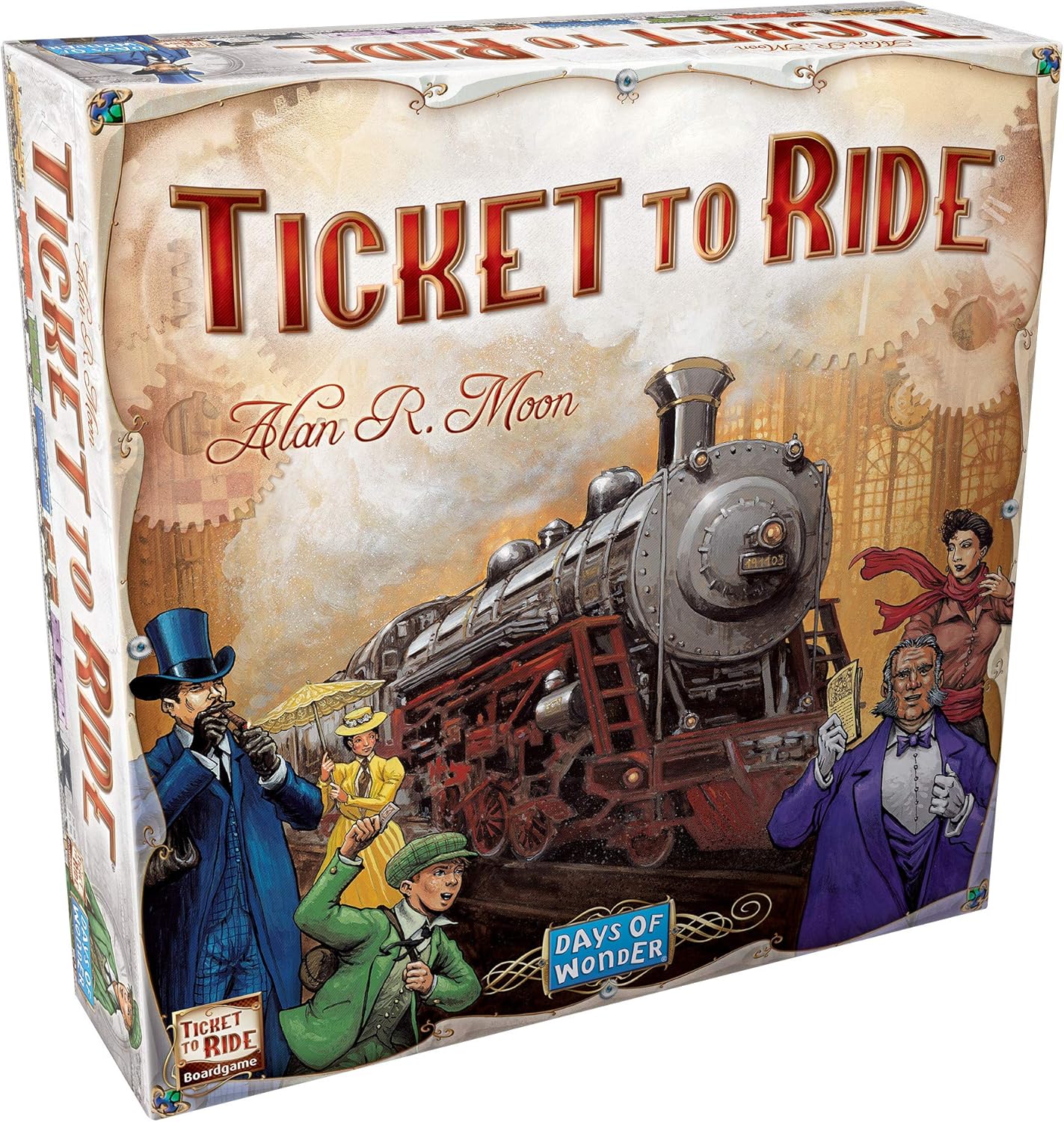
Match the beige original box and North America base-game listing. This guide uses its original rules, not the different component list of the 2025 refresh or the USA 1910 expansion. Seller-delivered packaging and availability have not been guaranteed.
The publisher lists ages 8+ and 30–60 minutes; these are guidance, not a guarantee of suitability or play length. The box warns of small parts and is not for children under three. We reviewed rules and supplier images, not a hands-on playtest, and do not include unverified Alexa or online-code features in the recommendation.