Puzzle Roll Mat or Rigid Case: Which Clears Your Table?

A roll mat saves your puzzle in a long bundle; a rigid case keeps a flat base and sorting areas together. Choose around your storage space and packing routine, or keep the board you already use.
If an unfinished jigsaw keeps taking over your shared table, choose its storage spot before buying another accessory. A roll-up mat suits a long, narrow space; a rigid case needs a broad place to rest. If a suitable board already lets you clear the table, you may not need either.
These are two separate Ravensburger products: Roll Your Puzzle 17956, a felt mat with a plastic tube, and Puzzle Store 17962, a closing rigid case. This comparison is based on product information and photos, not hands-on testing.
Choose the roll mat if flat storage is the problem
The Roll Your Puzzle kit contains a felt mat, a plastic tube, and two rubber bands. You assemble the puzzle on the mat, then roll it around the tube and secure it for storage. This is model 17956, not the older version with an inflatable tube.

The appeal is the change in shape: a wide work surface becomes a long bundle. Choose it if that shape fits your storage space and you are happy to roll and unroll the puzzle between sessions.

The trade-off is handling. You still need to roll carefully, and should not expect every loose piece to remain exactly where you left it. If the rolling step sounds frustrating, a rigid base is the more natural choice.

View the single Roll Your Puzzle 17956 mat kit on Amazon
Choose the case if you want a rigid base and sorting areas
Puzzle Store 17962 combines a separate puzzle base with five integrated sorting areas. You build on the base; to pack away, place that base above the sorting areas and snap the lid closed.

That layout makes sense if you regularly sort pieces into groups and want those areas within the same storage system. It also avoids rolling your work surface. The cost in space is a broad case, plus room for the open layout during a session.
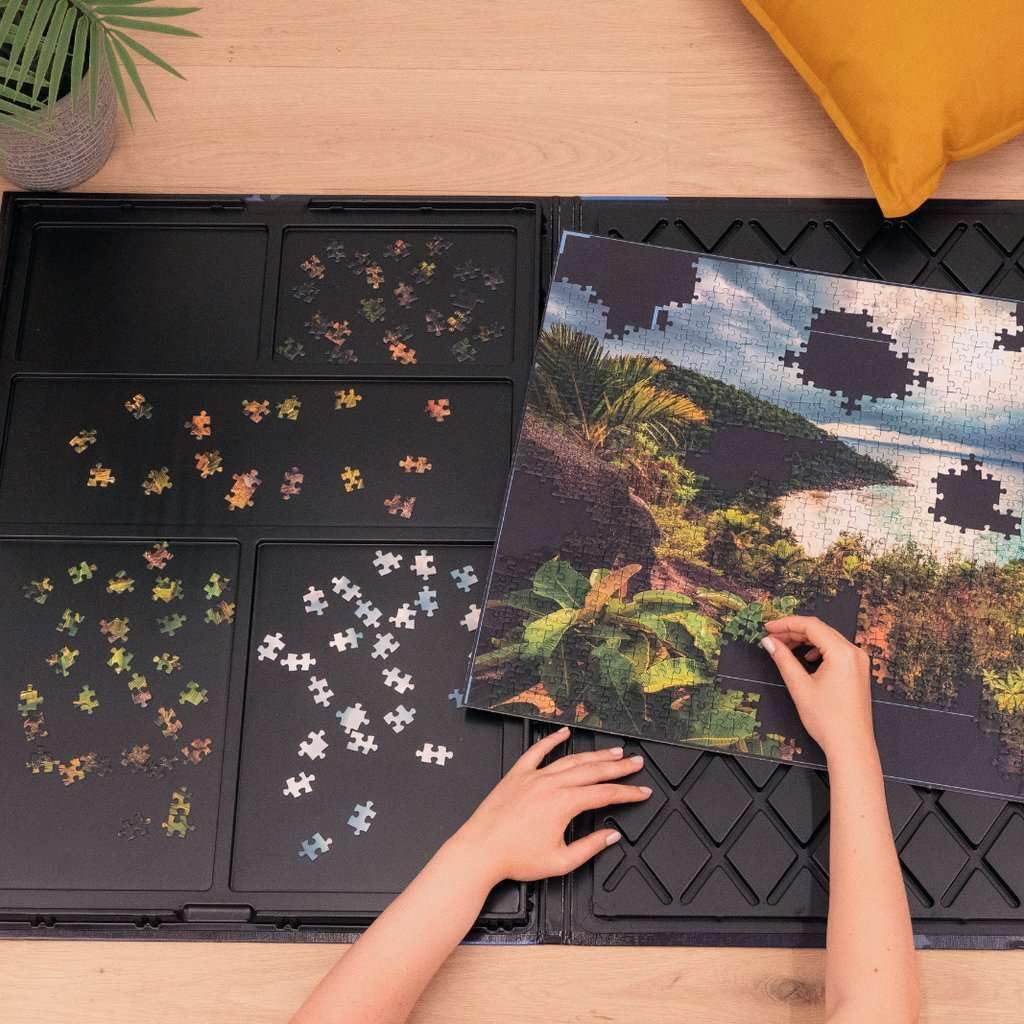
Do not assume it will fit under your sofa. Check the actual outer case dimensions and your storage opening separately from the usable puzzle area. A closed lid also does not establish drop protection, pet-proofing, or a guarantee that pieces cannot shift when the case is moved or stood upright.
View the single Puzzle Store 17962 case on Amazon
Check your next puzzle, not just its piece count
Ravensburger describes the mat as suitable for up to 1,500 pieces and the case for 500- and 1,000-piece puzzles. Those counts are a starting point, not a fit guarantee. Compare your puzzle’s finished width and height with the usable work surface, especially for panoramic or unusually shaped puzzles.
Both systems work best when you start the puzzle on their supplied surface. Neither should be treated as a simple way to scoop up a half-built puzzle already sitting directly on the table. Plan the change for your next puzzle unless you have a workable transfer method.
When keeping your board is the better choice
If your existing board is rigid enough to move, holds your whole puzzle, and has somewhere suitable to rest, keep using it. Add a new system only to solve a specific annoyance: no place for a broad board, nowhere to keep sorted pieces, or a need for a closing case.
Bottom line: choose the mat for its rolled storage shape, the case for its rigid base and integrated sorting, or neither if your current board already clears the table comfortably.