Plastic or Wood Cutting Board for Everyday Prep? OXO vs. John Boos

Choose the OXO Good Grips Utility Cutting Board if you want dishwasher cleanup and a groove for juicy ingredients. Choose the John Boos Chop-N-Slice 212 if you prefer a plain maple work surface and will hand-wash, dry, and oil it regularly. Both fit the everyday-prep role; the bigger difference is what happens after dinner.
Cleanup: OXO saves a hand-washing job
The OXO is dishwasher-safe. Its black end grips and non-slip feet are useful practical details, but the main reason to buy it is simple: you can clean the board with the rest of the dishes. At roughly 15 by 10½ inches, it still needs enough clearance in your dishwasher rack without blocking the spray arm.
The Boos is hand-wash only. Clean it with mild soap and water, towel-dry all surfaces, and let remaining moisture air-dry before putting it away. Do not soak it or put it in the dishwasher. If hand-washing is already the chore you skip, wood is not the convenient upgrade here.

Upkeep: maple comes with a maintenance routine
The Boos gives you a reversible, edge-grain maple board with eased corners and no plastic end grips. That makes it a good fit if you want a straightforward wood surface for chopping vegetables and prefer its appearance on the counter.
Budget for care as well as the board: John Boos calls for Mystery Oil at least monthly, adjusted for use and dryness, and recommends Board Cream for extra protection. Those products are sold separately. Let the oil absorb overnight and wipe off the excess. The manufacturer also advises against serrated knives and razor-edged cleavers on its wood boards, so this is not the choice for a board you mainly use with a bread knife.
The OXO avoids that wood-care routine. Its trade-off is that you are buying a utilitarian plastic board, not a maple surface that can double as part of your kitchen's presentation.
Surface: a juice groove or a plain edge
The OXO has a flat side and a grooved side with easy-pour corners. That channel is useful when cutting tomatoes or other juicy ingredients; it helps collect runoff rather than leaving you with a plain edge all around.
The Boos 212 is flat and reversible, without a juice groove. Choose it for ordinary chopping when a channel is not a priority, not as a substitute for a grooved carving board. Neither board is a tray for holding pools of liquid, and John Boos specifically warns against leaving liquids standing on the wood.

Storage: similar footprint, different thickness
The 16-by-10-inch Boos is in the same everyday size class as the OXO, not a large countertop butcher block. Its one-inch thickness takes more room in a narrow storage slot than the OXO's roughly half-inch profile. Give the wood board a dry storage spot rather than wedging it away while damp.
If your current board already gives you enough prep space and suits your cleaning routine, you do not need a second one just to try a different material.
Choose your option

OXO Utility: dishwasher cleanup
Dishwasher-safe, with a grooved side and easy-pour corners for juicy ingredients.
Keep in mind: A plain plastic appearance; its approximately 15-inch length still needs room in the dishwasher.
View on Amazon: OXO Utility: dishwasher cleanup (opens in a new tab)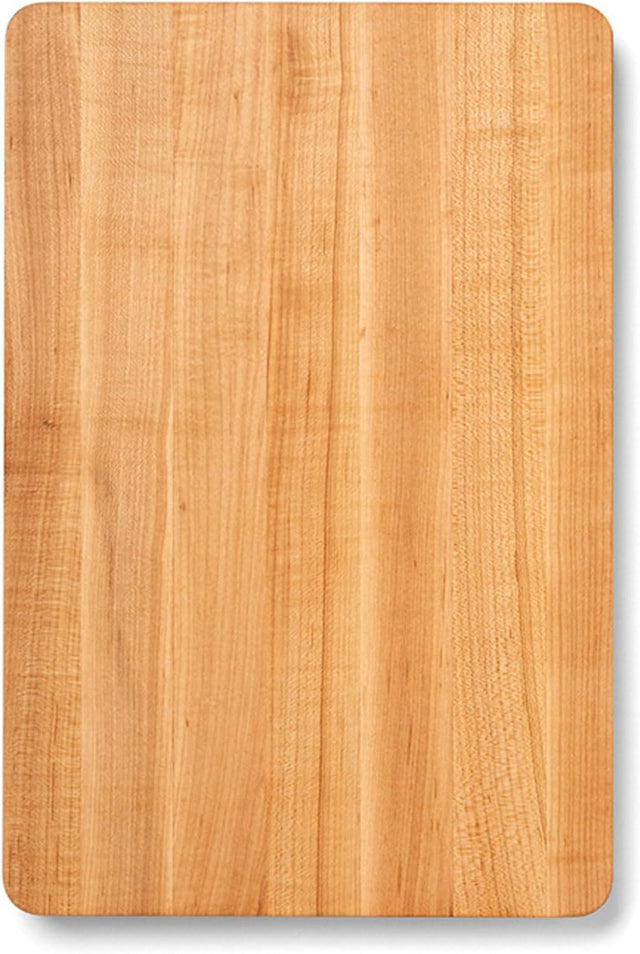
John Boos 212: plain maple surface
Reversible edge-grain maple with a flat, groove-free surface for everyday chopping.
Keep in mind: Hand-wash and dry; regular oiling, no juice groove, and no serrated knives per manufacturer care guidance.
View on Amazon: John Boos 212: plain maple surface (opens in a new tab)This comparison uses the manufacturers' product and care information and the specified Amazon listings. We have not tested these boards.