Is a Windshield Cleaning Wand Worth It for Hard-to-Reach Glass?

The Invisible Glass 95160 is worth considering when a deep dashboard or sloped windshield leaves glass out of reach. Here is what the single kit includes, the upkeep it adds, and when a hand-held cloth is enough.
If a deep dashboard or steeply sloped windshield leaves a strip of interior glass awkward to reach, the Invisible Glass 95160 Reach & Clean Tool is worth considering. Its long handle and pivoting microfiber head are designed for that reach problem. If a clean hand-held cloth already gets to the whole window comfortably, keep using it.
Choose the single yellow-and-black kit for occasional access to those awkward areas. The main trade-off is simple: you gain a handled tool, but also another item to store and two pads to wash. It does not replace choosing the right cleaner or using a clean cloth surface.
What to buy
The version covered here is model 95160, Amazon ASIN B01M9JUEQX, in the 1 Count (Pack of 1) option. It includes one tool, two reversible microfiber pads and a mesh storage bag. Glass cleaner and an extension pole are separate purchases.
Check those details before ordering. A cleaner bottle in a demonstration photo does not make this a cleaner bundle, and a different pack size is not the single kit discussed here.
See the Invisible Glass 95160 single kit on Amazon
Check the reach problem first
With the car parked, look at the area you struggle to clean. Is it the lower windshield beyond the dashboard, or an upper section where the slope leaves little room for your hand? Those are the situations a handled, pivoting pad is intended to address.
If the troublesome patch is already within reach, another tool may add little. A wand is also not an anti-fog treatment or a way to repair scratched glass. Buy it to position a microfiber pad farther from your hand, not to solve every reason a window looks hazy.

The head helps with angles, but fit still matters
The triangular head has a pivoting connection and a removable microfiber covering. That design gives you a different way to approach sloped glass than holding a cloth directly against it. The manufacturer also shows the head against curved side glass.
A photograph cannot tell you whether it will reach every corner of your particular car. Consider the space between the dashboard and glass, plus any trim that limits the path of the head. Keep a suitable hand-held cloth for accessible edges rather than expecting the wand to replace it everywhere.

Two pads still need care
The included waffle-weave microfiber pads can be removed, reversed and washed. A clean side is useful when the side touching the glass becomes dirty. The spare also gives you another pad to use, but neither stays clean indefinitely.
In its use directions, the manufacturer tells you to apply cleaner to the attached microfiber, avoid over-saturating it, turn to a clean side and dry the glass. Excess liquid can leave streaks. The tool alone does not guarantee a streak-free finish.
Follow the care instructions for your vehicle’s glass, window film or coating, as well as the cleaner’s directions. Do not assume a cleaner is suitable for every surface just because you are applying it with microfiber. Wash the pads without fabric softener and let them air-dry completely before putting them away.

The handle does not come with an extension pole
The black foam grip ends in a yellow hanging-loop cap. The manufacturer’s image shows that removing this cap exposes a connection for a standard threaded pole. That is an optional attachment, not a supplied extension or a telescoping handle.
For an interior windshield, start by deciding whether the tool itself addresses the awkward spot. Do not add a pole automatically. If you do need one for another glass-cleaning task, confirm compatibility first; the image does not establish that every third-party pole will fit.

Our buying call
We would choose the 95160 for a recurring reach problem behind a deep dashboard or along sloped glass, provided you have room to store it and will keep the pads clean. Skip it if your existing microfiber cloth already does the job. Use it only while the car is parked, and judge it as a reach aid rather than a promise of faster cleaning or a flawless finish.
Check the 95160 single-kit details on Amazon
Where to buy
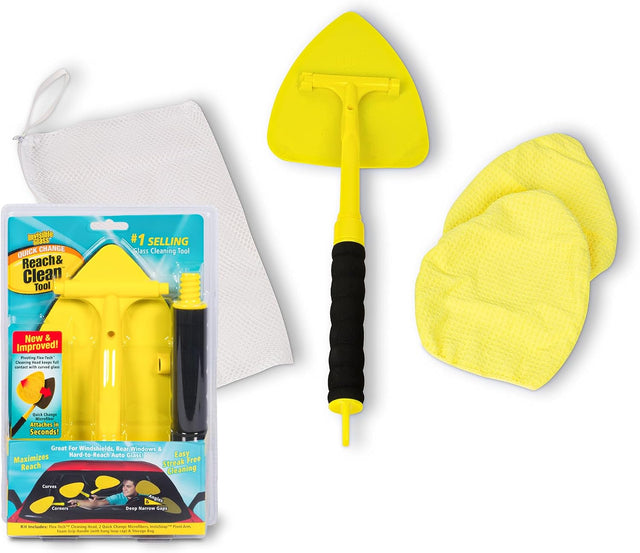
Invisible Glass 95160 — yellow/black tool, two reversible microfiber pads and mesh bag, one kit
A deep dashboard or sloped windshield leaves a recurring area beyond comfortable reach with your existing cloth.
Keep in mind: Adds storage and pad care. Cleaner and extension pole are not included; fit and streak-free results are not guaranteed. Use only with the car parked.
View on Amazon: Invisible Glass 95160 — yellow/black tool, two reversible microfiber pads and mesh bag, one kit (opens in a new tab)Choose the item from this guide